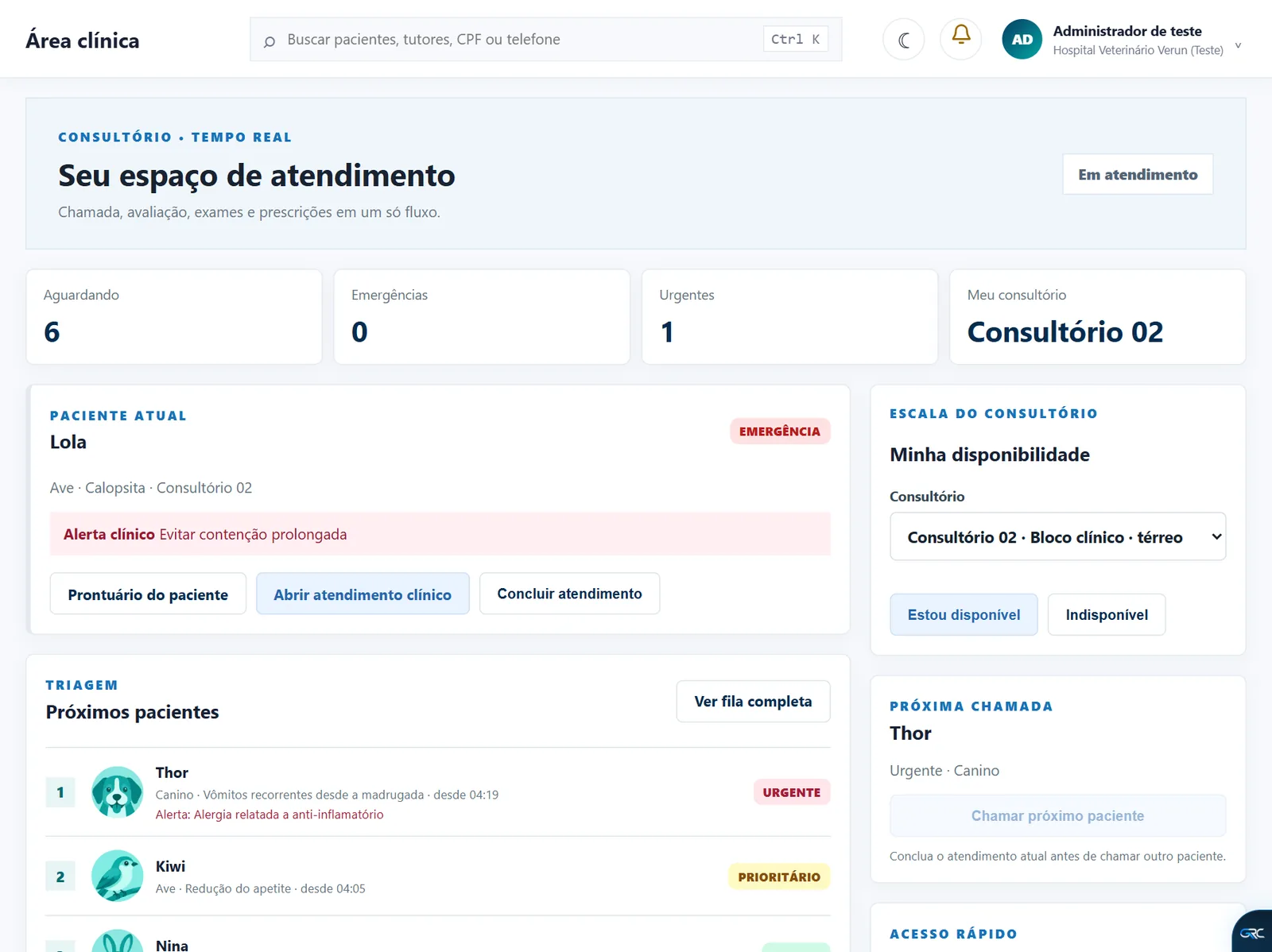
Every hospital department seeing the same patient.
Front desk, exam rooms, diagnostics, nursing and pharmacy working from the same record, with clinical prioritization, medication traceability and an audit trail. For those who need to make informed decisions and answer for every dose.
Four questions every hospital needs to answer fast.
When the answer depends on digging through paper, asking in the hallway or checking a spreadsheet, the problem has already happened. In Verun Vet, the answer is in the record.
Who should be seen right now?
Emergencies competing for attention with routine appointments, across several exam rooms at once.
In Verun VetA single queue with four priority levels: emergency, urgent, priority and routine. Within the same level, order of arrival applies. Each veterinarian indicates which exam room they are available in and calls the next patient.
Where did this medication go?
Inventory that doesn't reconcile, unexplained losses and controlled drugs without a clear trail.
In Verun VetEvery dispensing to a patient is linked to the patient, the batch and the person who administered it. Disposal and loss require a reason, and the physical count becomes a recorded adjustment: the balance is never edited by hand.
Was this report changed?
Results corrected after delivery, with no way of knowing what changed or why.
In Verun VetA released report is never overwritten. An amendment requires a reason, keeps the previous version and notifies the professional who ordered the test.
Who did what, and when?
Large teams, different shifts and shared logins.
In Verun VetEach professional signs in with their own user account and accesses only what their job requires, by role, unit and department. Relevant operations are logged with user, date, time and IP address.
The workflow in practice
Watch a visit unfold, step by step.
Scroll down and follow the patient’s path through Verun Vet, from first contact to checkout.
Step 01 / 09
The pet owner arrives
They take a ticket at the front-desk kiosk. Tickets are numbered daily and printed.
The front desk calls
The call appears on the TV display, with a sound, showing which service desk to go to.
Check-in
The front desk confirms check-in from the ticket and sets the clinical priority and reason.
Severity-based queue
Emergencies move to the top; within the same level, order of arrival applies. The vet calls the next patient from their exam room.
Exam room
A clinical history structured in 13 fields, with the patient’s clinical alerts in view.
The visit branches out
On the same screen, the vet orders tests, prescribes and schedules procedures. Each order goes straight to the department in charge.
Each department delivers
The technician attaches the test and report to the order, and the vet is notified. Nursing administers with the batch recorded and stock deducted. The procedure goes on the 24-hour board.
All in the medical record
Visits, tests, medications and procedures come together on the patient’s timeline.
Invoice and cash flow
Private or insurance-plan invoice, the owner signs on screen, and payment is posted straight to cash flow.
Scroll to continue
Department by department
How the hospital runs on Verun Vet.
Each team has its own workspace, but all of them read from and write to the same medical record.
Front desk
Queue ticket from the self-service kiosk and call on the TV display, with sound
Check-in with priority level and reason for visit
Service points (booths and counters) with operator presence
Full history of each queue ticket: issued, called, recalled, no-show
Exam rooms
Clinical area with availability, next call and open consultations
Emergency and urgent case counters always visible
Structured clinical history (anamnesis) in 13 fields, from reason for visit to clinical plan
Test orders and prescriptions without leaving the consultation
Diagnostics
Test catalog by performing department: laboratory, imaging, cardiology, pathology
Workflow: requested, accepted, in progress and completed
Report editor with tables and up to 10 attachments (PDF or image)
Ordering professional notified when the result is released
Nursing
Pending medications organized by department
Preparation and administration with batch and quantity recorded
Automatic inventory deduction, linked to the patient
Label with barcode and QR code
Pharmacy
Batches with expiration date and status: available, quarantine, blocked, expired
Prescribed items outside the catalog linked with equivalence confirmation
Controlled drugs classified by regulatory list and required prescription type
Returns by scanning the label, straight to quarantine
Hospital schedule
Procedures by patient, department, responsible professional and severity
24-hour map of the day, with the progress of each procedure
Calendar invite (.ics), QR code and Google Calendar
Status: scheduled, in progress, completed or canceled
Controlled drugs coming soon
Chain of Custody ready for inspection.
For each controlled drug, a PDF document with the complete movement history, from the oldest record to the most recent, on the hospital's letterhead. The foundation already exists in Verun Vet: every receipt, dispensing, return, disposal and adjustment is recorded with the responsible person, date and reason.
PDF with the institution's logo and details
Drug, regulatory list, batch and period in the header
Movements in chronological order, with the balance after each one
Patient, prescription, operator and reason in each record
Signature line for the pharmacist/veterinarian in charge
Hospital logoLegal name · Tax ID (CNPJ) · addressChain of Custody
Drug
Methadone 10 mg/mL
List
Ordinance 344/98 · A1
Batch
L0001
Period
Oct 1–Oct 31
Date
Movement
Qty.
Balance
Oct 2, 08:14
Stock in · delivery received
+20
20
Oct 3, 14:52
Dispensed · patient Thor
−1
19
Oct 5, 09:30
Dispensed · patient Luna
−2
17
Oct 7, 17:05
Disposal · damaged ampoule
−1
16
Pharmacist/veterinarian in charge
Multidisciplinary team
Ready-made roles for every function in the hospital.
Each role comes with the permissions its function requires. When someone needs more, administrators grant individual permissions and define the units and departments of each professional.
Clinical medicine
Surgery
Anesthesia
Large animals
Diagnostic imaging
Radiology
Laboratory
Pathology
Nursing
Inpatient care
Pharmacy
Front desk
Administration
Hospital pharmacy
The next step for the hospital pharmacy: automated dispensing cabinets.
Automated dispensing cabinets (ADCs), common in human hospitals, are beginning to reach veterinary medicine. Verun Vet was designed to connect them to the medical record and inventory, with a vendor-neutral architecture and project-based implementation.
Verun VetPrescription, patient, inventory by batch
Automation gatewayNeutral layer between the system and the manufacturers
Automated dispensing cabinetControlled drawers and compartments
How we get started
From first contact to a configured system.
ConversationYou tell us how the hospital works: departments, teams, volume and where the bottlenecks are.
DemoWe show the system in action, in the real workflow of front desk, exam room, diagnostics and pharmacy.
ProposalWe send a proposal with the modules that make sense for your operation.
ConfigurationModules, roles, test and medication catalogs, price list and letterhead.
Frequently asked questions
Hospital FAQ
Does the system support several exam rooms and departments at the same time?
Yes. There is a single queue ordered by severity, each veterinarian indicates the exam room where they are available, and nursing, diagnostics and the hospital schedule are organized by department.
Is there an inpatient module?
Today Verun Vet covers queue and consultations, prescribing, nursing with batch-level administration and a procedure schedule by department. A dedicated inpatient care module, with beds, progress notes and shift handoff, is part of the development roadmap and is not yet available.
How are controlled drugs handled?
Each controlled item is classified by regulatory list (such as the lists in ANVISA Ordinance 344/98 (Brazil) and the MAPA (Brazil's Ministry of Agriculture) lists) and by the required prescription type, and dispensing a controlled drug requires a reference to the prescription. The prescription printed by the system does not replace the official notification form or special control prescription.
Can we limit what each professional sees?
Yes. Each user has a role with the permissions of their function, can be granted individual extra permissions and is restricted to the authorized units and departments.
Can we enable only part of the system?
Yes. Front desk, clinical care, diagnostics, hospital schedule, pharmacy and finance are independent modules. Disabling a module hides its screens without deleting any data.
Shall we see Verun Vet in your hospital's workflow?
Schedule a demo. We will show the system with your departments in mind and send a tailored proposal.
Analytics cookies. With your permission, we use Google Analytics to understand how the site is used and to improve it. No data is used for advertising. Learn more